The Mad, the Maimed, and the God-Touched
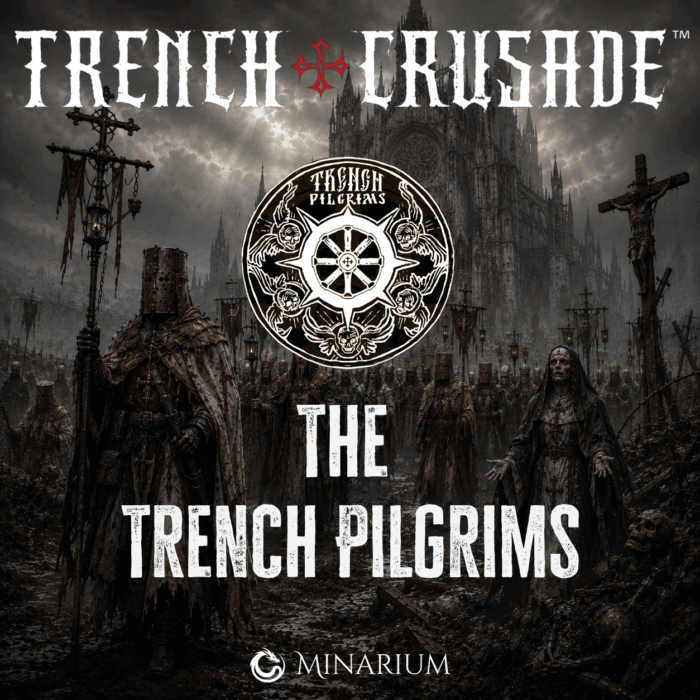
If you’ve been looking into Trench Crusade and wondering which faction screams “absolute chaos fueled by religious conviction,” look no further than the Trench Pilgrims. These aren’t soldiers. They’re not really even an army in the traditional sense. They’re farmers, beggars, monks, nuns, lepers, and sinners who’ve packed up whatever weapons they could find and marched straight into the worst war the world has ever seen. Not because anyone ordered them to. Because God told them to.
Or at least, that’s what they believe.
The World They March Into
To understand the Pilgrims, you have to understand Trench Crusade’s setting. This isn’t our World War I. About 800 years before the game’s events, someone opened the Gates of Hell in Jerusalem, and the forces of Hell have been at war with humanity ever since. The conflict has been raging for centuries by the time the game takes place, settling into a grim, industrialized meat grinder of trench warfare somewhere in a blasted, corrupted No Man’s Land.
There are organized factions fighting this war. The Principality of New Antioch has trained soldiers, proper equipment, and command structure. The Iron Sultanate brings its own discipline and ancient power. These are real armies.
And then there are the Pilgrims.
Who Are They, Really?
The Trench Pilgrims don’t belong to any nation. They carry no banners of state. They are, at their core, the common people of Christendom who have decided that sitting at home is no longer an option when Hell itself is marching across the earth.
Communities of displaced, faithful refugees have been a feature of this world for a long time. Records of these “sacred processions” stretch back to the Wars of Triclavianism in the 13th century. But the first true modern Pilgrimage, called the Procession of the Sacred Affliction, formed at the beginning of the Corpse Wars in 1894. From there, the movement exploded.
They’re organized into groups called Processions, each one gathering around a Prophet or Prophetess who claims to receive divine visions guiding the warband from battlefield to battlefield. Some are driven by guilt, seeking redemption. Some are devout in a way that borders on madness. Some are simply people who lost everything to the war and decided that dying fighting was better than dying waiting.
When you join a Procession, you give up everything. Literally. Your money, your land, your valuables, all of it goes to the elders of the pilgrimage. You own nothing. You are a weapon of God now.
Not Exactly Welcome
Here’s the interesting tension that makes the Pilgrims so compelling as a faction: the Church doesn’t officially endorse them. The Holy See hasn’t sanctioned the Pilgrim Processions, and some within the Church actually condemn them, viewing their Prophets’ preachings as dangerously heterodox. The Pilgrims operate in a kind of spiritual gray zone, simultaneously seen as heroic fighters against Hell and as potential troublemakers the establishment would rather have dying in the trenches than causing problems back home.
Despite that, the Church still blesses their crusades. Useful fanatics, essentially. They show up on the front lines in huge numbers, charge into things that trained soldiers hesitate to charge into, and they don’t stop. The Pilgrims are fine with this arrangement. Martyrdom is kind of the point.
How They Fight
The Pilgrims’ battlefield strategy, if you can call it that, is about as subtle as a Molotov cocktail to the face (which, incidentally, is a weapon they invented). They arm themselves with whatever they can get their hands on, from centuries-old muskets to scourges, warcrosses, and improvised explosives. In regions of the Holy Roman Empire where peasants aren’t allowed to carry normal weapons, they’ve developed metal projectiles shaped like crucifixes. Whatever works.
Their charges across No Man’s Land are legendary and terrifying to witness. They don’t advance carefully. They rush. They scream. They go.
Leading the Charge
War Prophets & Prophetesses
The charismatic leaders of each Procession. They receive divine visions that direct the warband's movements and drive them ever forward. Powerful fighters as much as spiritual guides, they burn with a need to find martyrdom on the battlefield.
Communicants
Some Pilgrims consume the flesh and blood of a Meta-Christ, a divine being whose essence transforms them. They grow to enormous size, heal at a terrifying rate, and become near-unstoppable in close combat. To prove their devotion, they nail blessed crosses through their own eyes.
Stigmatic Nuns
Nuns who draw supernatural strength from their wounds. The more they suffer, the stronger they become. Their stigmata are not just spiritual, they're tactical.
Castigators
Think of them as a cross between a priest and a political officer. They literally whip the troops forward, instilling the Fear of God in anyone who hesitates. They can strike friendly models to keep morale from breaking. Harsh, but effective.
Ecclesiastic Prisoners
Sent out ahead of the main charge, these are either captured enemies doing a final act of contrition or volunteer sinners seeking redemption. Each one is strapped with high explosives detonated when they reach enemy lines. Grim, but very on-brand for the Pilgrims.
Martyr-Penitents
Fallen Pilgrims deemed worthy by the Seventh Meta-Christ and returned from the edge of death. Halfway between the living and the divine, they feel no pain from bullets or bayonets and fight on regardless of what their bodies say.
There are also Anchorite Shrines: ancient, hulking suits of machine armor piloted by devout priests who stride into the melee and crush everything in reach. These are rare, but when a Procession gets one, you know things are about to get very bad for whoever is on the receiving end.
The Processions: Different Flavors of Faithful
Not all Pilgrim warbands are the same. Different Processions have developed their own traditions, beliefs, and ways of making war. Three of the most notable are:
Procession of the Sacred Affliction
The original and most iconic Procession, built around close combat and featuring the Leper-Pilgrims: fighters ravaged by disease who have nothing left to fear. They were the first true warband of the modern Pilgrim movement and remain the most recognized.
War Pilgrimage of Saint Methodius
These Pilgrims follow a stricter Orthodox creed and break with many common Pilgrim practices. They reject the Communicants as heresy and condemn martyrdom devices as violations of God's law against suicide. Ironically, they also field the Anchorite Shrines, armored priests who are arguably the most powerful single units the Pilgrims can bring to the field.
Cavalcade of the Tenth Plague
Before every battle, this Procession sacrifices lambs and anoints themselves in the blood, drawing holy symbols on their bodies, armor, and clothing. They march to battle singing hymns, absolutely certain that the blood of the sacrifice shields them from harm. Whether it does or not is a matter of theology. What's not in question is that they fight like nothing can kill them.
Why They're Worth Your Attention
The Trench Pilgrims are frequently recommended as a great starting faction for Trench Crusade, and it’s easy to see why. Their playstyle is clear, get close, hit hard, and don’t stop, but there’s a ton of room for personality in how you build and paint them. They also have one of the richest lore identities in the game. Every model in your warband has a story: the penitent who gave away everything, the Prophet who hears God speaking through the artillery fire, the Communicant who stares at nothing with blessed crosses where their eyes used to be.
They’re the underdogs of the setting. They’re not fancy. They’re not powerful. They’re just people who believe, completely and without reservation, that God is watching and that dying for Him in this war is the best thing they could possibly do with their lives. In a game full of ancient orders, demon-serving heretics, and armored crusader states, there’s something genuinely striking about a warband built entirely around regular people deciding that faith is all the armor they need.
Well. Faith, a scourge, a Molotov cocktail, and maybe a giant man with crosses through his eyes.