The Wall Between the World and Hell
While the Trench Pilgrims sprint screaming into No Man’s Land and the armies of New Antioch hold the line with steel and prayer, there is another faction doing something that might actually be harder than either of those things. The Iron Sultanate has been standing directly next to the open Gates of Hell for over 800 years. Not retreating. Not praying for rescue. Building. Fortifying. Inventing weapons, training soldiers, crafting living things in laboratories, and holding a wall that separates the faithful world from the heart of Hell’s domain. They are the front line that never moves, and they have been there from the very beginning.
How It All Started
The Trench Crusade timeline splits from our own history at 1099, when the First Crusade stormed Jerusalem. In this world, the Knights Templar did something catastrophic: they opened the Gates of Hell. Whether through arrogance, heresy, or something else entirely, the act unleashed the forces of Inferno onto the earth, and the people nearest to that disaster were the Muslim populations of the Levant and the Middle East.
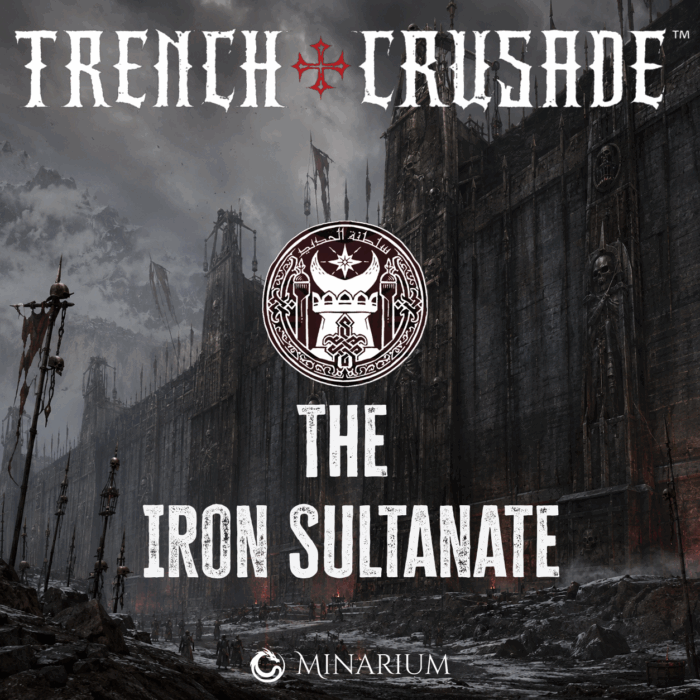
When the abyssal gates tore open and Heretic forces began pouring out, threatening to consume everything nearby, something miraculous happened. As written in the faith, and as promised to the righteous, the great Iron Wall of Dhu al-Qarnayn manifested itself in the lands of the Sultan of Rum. A divine bulwark, tens of thousands of kilometers long, rising to close off the path between the corrupt territories and the lands of the faithful.
A call went out. Over the following decades, Muslims from across Europa, Asia, and Africa answered. It was described as the greatest migration since the Hijrah of the Prophet himself. People moved their entire lives to gather behind the Wall and defend what it protected. By 1109 the migration was complete, the Gates of al-Qarnayn had been sealed, and the Iron Sultanate was formally born as a nation.
They have been at war ever since.
What the Iron Wall Actually Is
The Wall is not just a defensive structure. It is the defining fact of everything the Sultanate does. Their military exists to defend it. Their science exists to improve it. Their culture has been shaped entirely by 800 years of living in its shadow, knowing that the other side of it is Hell.
Azeb sharpshooters stand ready at every battlement. Janissary regiments are barracked at set intervals so they can respond to any attack at speed. The artillery of the Sultan watches the horizon constantly. When a major incursion comes, the full muster of Azebs is called, the House of Wisdom sends its artificial creations into the field, and if things get truly dire the Sultan himself leads the Janissaries forward under the green flag of the Prophet.
Beyond the Wall, the Sultanate sends out small, mobile companies on specific missions: hunting down Heretic forces, recovering relics from the time of the Prophets, and salvaging books of knowledge from the ruins of fallen caliphates. These are not just soldiers. They are scholars, engineers, and spies operating in the most dangerous territory on earth.
Who They Are and How They Fight
The Iron Sultanate is a combined arms faction in the truest sense of the phrase. They do not specialize in one thing. They have conscripted light infantry, elite shock troops, demolitions experts, alchemical monsters, shadow assassins, and walking artillery all working together in a layered, methodical fighting style that rewards patience and positioning over suicidal charges.
Where the Pilgrims rush in and the Heretic Legions overwhelm with variety and hellish power, the Sultanate pulls enemies across a killing ground of their own design. Azebs bait and skirmish. Sappers seed the field with traps and obstacles. Artillery hammers anything trying to advance. And when the enemy finally reaches the Sultanate’s lines, the Janissaries are waiting.
The Sultanate’s full official name is the Great Sultanate of the Invincible Iron Wall of the Two Horns that Pierce the Sky. In practice, everyone just calls it the Iron Sultanate. It is, by any measure, the largest Islamic nation in the world, and its borders are defined almost entirely by where the Wall stands and what it protects.
Leading the Charge
Yuzbaşı Officers
The leaders of Sultanate warbands. These are chemically enhanced commanders who have earned their position through military excellence and a dedication to the Sultan's cause. They direct the layered fighting style of the Sultanate, holding their forces back until the moment is right, then driving forward with devastating precision.
Azebs
The backbone of the Sultanate's forces. These conscripted soldiers are drawn from the general population, with one household in twenty required to arm and equip a fighter. They are light, fast, and deliberately expendable: recruited exclusively from single, childless civilians to keep mourning behind the Wall to a minimum. In battle they are experts at feigned retreat and skirmish tactics, drawing enemies into the Sultanate's trap.
Sultanate Assassins
The most mythologized fighters in the Sultanate's arsenal. The Assassins of Alamut have mastered occult techniques that allow them to bend space and time, appearing in two places at once, warping their bodies through alchemical rites to move faster and hit harder than any ordinary human. Armed with poison blades, they hunt enemy commanders and specialists with surgical violence. They are killers beyond compare.
Brazen Bulls
Monstrous artificial beings of immense power and vitality. Brazen Bulls are so physically overwhelming that they are the only units in the Sultanate capable of carrying the heaviest artillery pieces. They do not just carry cannons into battle. They are cannons that happen to walk. Single-minded and fearless, their constant firing makes the ground shake and disrupts enemy formations before they can even get close.
Janissaries
The Sultan's elite household troops. Captured during raids beyond the Iron Wall and subjected to rigorous martial training and indoctrination from an early age, the Janissaries are the most feared close-combat fighters the Sultanate fields. They excel at devastating counter-charges, crushing enemy elite formations and acting as personal guards for commanders.
Sappers
Valued specialist soldiers and the Sultanate's engineers. Sappers handle everything from clearing minefields to fortifying positions to rigging the battlefield with demolitions before the enemy ever arrives. A battlefield shaped by Sappers is a nightmare to advance across, which is exactly the point.
Lions of Jabir
Artificial creatures produced by the alchemists of the House of Wisdom, the Lions of Jabir are fast-moving shock troops designed to tear through enemy flanks at close range. They lope across the battlefield with terrifying speed and hit like a freight train once they get there. In a Sultanate warband, they are the hammer after the Azebs and Sappers do their work.
Homunculi
The stranger products of the House of Wisdom's laboratories. Homunculi are custom-built artificial beings that can be configured with a dizzying variety of upgrades: extra limbs, regeneration, wings, enslaved minds, terrifying appearances. Every one is different. Every one is unsettling. They are the Sultanate at its most experimental, and sometimes its most effective.
The House of Wisdom
You cannot talk about the Iron Sultanate without talking about the House of Wisdom. It is the pre-eminent center of learning in the Sultanate and possibly in the entire world. The Alchemists who work there have been developing weapons, creatures, and tools of war for centuries, driven by the very practical need to find new ways to kill things that come from Hell.
The takwin, the Sultanate’s term for their artificially created life forms, are the most visible product of this work. Lions, Bulls, Homunculi, and stranger things have all come out of those laboratories. The House of Wisdom also produces alchemical ammunition, elemental weapons, and devices capable of bypassing defenses that conventional firepower cannot touch. In a setting where your enemies might literally be made of hellfire, having the best scientists in the world on your side matters a great deal.
The Three Variants: Different Ways to Guard the Wall
Like the other factions, the Iron Sultanate has three distinct warband variants, each built around a different pillar of the Sultanate’s military.
Fida'i of Alamut: The Cabal of Assassins
The Assassins get their own faction. Where the standard Sultanate allows one Assassin per warband, the Fida'i of Alamut can field up to three, with one elevated to Master Assassin status. The regular infantry here are called Dervishes rather than Janissaries, whirling warrior monks who can literally hypnotize enemies with their fighting style. This is the fastest, most elite, hardest-to-pin-down version of the Sultanate: a swift, shadow-focused force that targets leaders and specialists and vanishes before the enemy can respond.
The House of Wisdom
If the Fida'i are about blades and shadows, the House of Wisdom variant is about laboratories and monsters. This warband leans heavily into the Alchemists and their takwin creations, allowing for expanded use of Homunculi and artificial units. The Alchemists themselves become core to the warband's fighting ability, and access to weapons from allied factions' armories means the House of Wisdom can field combinations of equipment that no other Sultanate warband can. Equal parts research institution and fighting force.
Defenders of the Iron Wall
The most straightforward of the three variants, and in some ways the most powerful. The Defenders lean into the Sultanate's core strength: the Janissaries. With expanded elite infantry options, fortification abilities, and a fighting style built entirely around holding ground and crushing counter-attackers, the Defenders represent the Iron Wall itself made into a warband. They do not retreat. They do not rush forward recklessly. They stand, they hold, and they make advancing against them brutally expensive.
What Makes Them Different
The Iron Sultanate occupies a unique position in Trench Crusade that no other faction quite matches. They are the only Faithful faction that has been physically adjacent to Hell’s domain since the very beginning. New Antioch fights the war. The Pilgrims throw themselves into it. But the Sultanate lives on its border, permanently, generation after generation. Every soldier behind the Wall grew up within earshot of what’s on the other side.
That creates a faction with a completely different relationship to the war. This is not a crusade for the Sultanate. It is a homeland defense. Their science, their architecture, their military doctrine, their entire culture has been shaped by 800 years of a single mission: hold the Wall, push back Hell, and protect everyone standing behind you.
On the tabletop, they reward players who like thinking several moves ahead. The layered fighting style, the mix of expendable infantry and terrifying elites, the alchemical creations and the shadow assassins, all of it comes together into a faction that feels genuinely different from the charge-and-pray style of the Pilgrims or the raw aggression of the Heretic Legions.
They are not the loudest faction in this war. They are not the most dramatic. But they have been there the longest, they know the enemy better than anyone, and the Wall has never fallen.
That counts for something.