
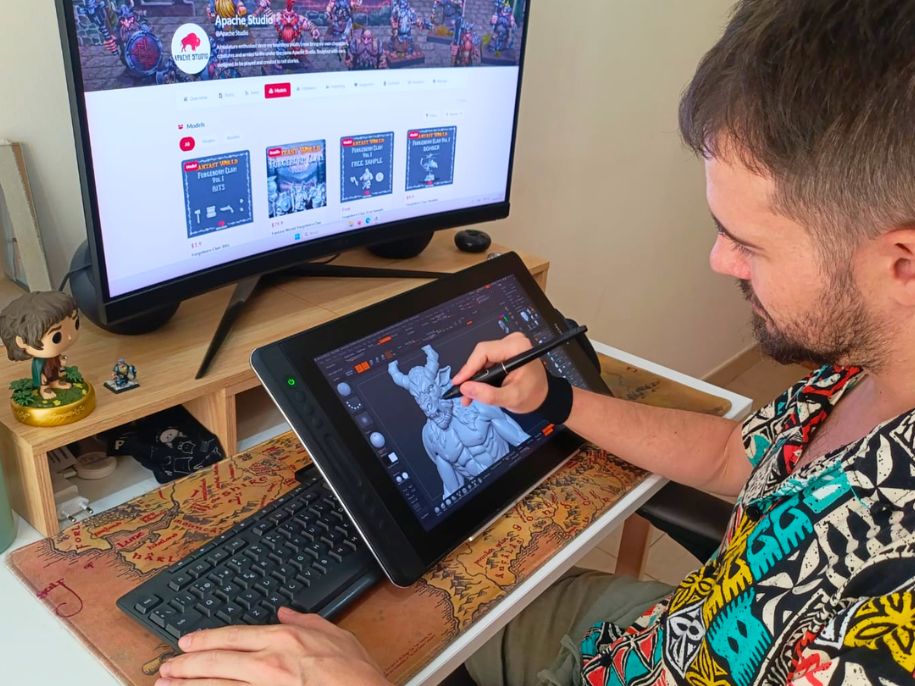
Some creators find their path early. Mario Siles found his in the middle of a pandemic, staring down a career in civil engineering that wasn’t making him happy, when an ad for a master’s degree in digital sculpting with ZBrush landed in front of him. Something clicked. Today, Mario runs Apache Studio and sculpts miniatures full time. The road between those two points says a lot about what it actually takes to become a working artist, and even more about why he’s building his future on Minarium.
No Money, but Plenty of Green
Mario’s relationship with miniatures didn’t start with software. It started with a problem every broke student wargamer knows: the units you want are always the expensive metal ones. As a Warhammer Fantasy player without much of a budget, Mario bought cheaper plastic kits instead and converted them himself, changing poses and sculpting chainmail and armor details by hand with green stuff.
That instinct to build something better out of limited resources turned out to be the whole story. Years later, after training with Barruz Studio and releasing his own projects on the side, Mario made the leap to sculpting full time. He’s candid about the uncertainty that still comes with it. “I still don’t know whether it will be economically sustainable forever,” he says, “but I love what I do and I want to give it a real chance.” That’s not a line from someone chasing hype. It’s a working artist telling the truth about the bet he’s making on himself.
Building a Culture, Not Just a Model
Ask Mario how a new range begins and he doesn’t start with a single miniature. He starts with an identity.
Take his dwarves. He didn’t want to make another set of cheaper proxies for existing armies. He wanted a culture: traditional and craftsman-like, but built with modern proportions and clean volumes that would actually be enjoyable to paint. He pushed the anatomy further than most dwarf sculpts dare, exaggerating the skull shape and giving them bold, bulbous noses, a choice inspired by the fantasy character work of illustrator Paul Bonner.
That’s the throughline in everything Mario makes: a classic miniature soul paired with modern readability. He’s also a painter himself, so every sculpt gets built with the brush in mind. Clear shapes. Readable detail. Nothing so packed with micro-texture that it looks great in a render and falls apart on the tabletop.
He also builds his ranges to be inclusive on purpose, not as an afterthought. His latest dwarf warband includes an engineer who uses a wheelchair. “Wargaming is an incredibly rich hobby,” he says, “and I think everyone should be able to find a place in it.” That’s a sculptor thinking about who gets to see themselves on the table, not just what will sell.
The Part Nobody Sees
Mario is unusually honest about the gap between what people see and what actually goes into a finished miniature. “The amount of work behind the final product” is what he thinks outsiders underestimate most. Customers see a price tag. They don’t see the hours of sculpting, the decisions, the failed attempts that never shipped.
He’s felt the sharper edge of that misunderstanding too. He once received a comment dismissing one of his ranges as “AI garbage,” despite there being nothing AI-generated in it at all. It’s a small moment, but it points to something bigger: creators today are fighting for recognition of their actual hands-on skill in a landscape that’s increasingly suspicious, or exhausted, or both.
Mario’s answer to all of it isn’t to complain louder. It’s to grow gradually, stay transparent about his process, and build a genuine audience around the actual work. That’s the kind of long game that doesn’t photograph well for a highlight reel, but it’s exactly the kind of long game a real platform should be built to support.
Full Circle With the Forgeborn Clan
When asked which project he’s proudest of, Mario doesn’t hesitate: his Forgeborn Clan dwarf range and its skirmish counterpart, Embervein Delvers.It’s the first fantasy wargaming range where he felt he’d truly found his direction. It’s also personal. Dwarves were where his own miniature obsession began, back when The Lord of the Rings first pulled him into epic fantasy and, eventually, into wargaming.
“Sculpting my own dwarf range feels like completing a circle,” he says. And the payoff isn’t abstract. It’s the photos. People around the world printing, painting, and collecting his miniatures, then sending him pictures of the finished result. He still lights up every time.
Why Mario and Apache Studio Belong on Minarium
Mario’s story is the story Minarium was built to support. Not a creator chasing an algorithm, but an artist trying to build a sustainable, honest career doing work he values. Someone who thinks about culture and identity before he thinks about a single polygon. Someone who’s transparent about the tension between art and income instead of pretending it doesn’t exist.
Minarium exists to back creators like Mario at every stage of that fight. That means treating creators as partners, not vendors. It means building tools that make the human side of creation visible instead of burying it under fees and fine print. It means giving an artist like Mario a platform where his craftsmanship, his worldbuilding, and his honesty about the hard parts of this job are the whole point, not an afterthought.
Mario spends his days finding the balance between the artist who wants to chase a strange new idea and the professional who needs to feed a family. Minarium is built for exactly that person: a working creator, choosing every day to make something real. We thank Mario for sharing his story with us.