
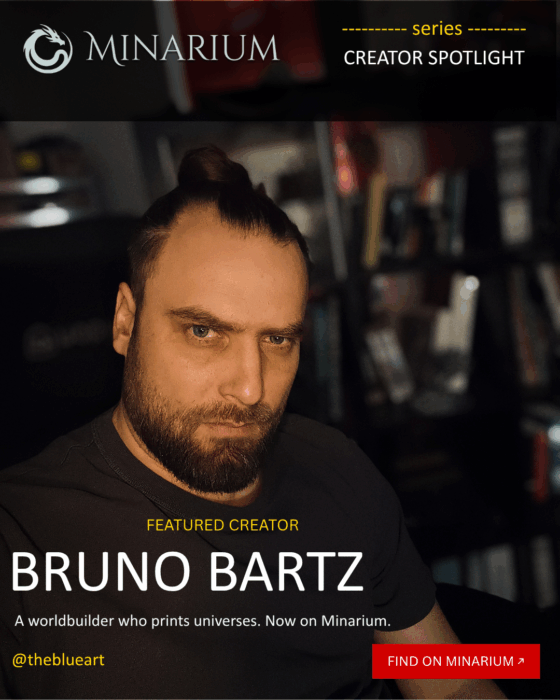
There’s a moment every serious hobbyist knows. The one where appreciation flips into ambition. Where you stop looking at a miniature and start wondering if you could build something better yourself. For Bruno, that moment came when he returned to Warhammer 40K with his brother and thought: this is cool, but I’d love to make something different. Something that’s more me.
That spark didn’t just lead to a new hobby. It led to an entirely new career, and to some of the most distinctive, technically accomplished 3D printable miniatures in the community today.
Building Worlds, Not Just Models
Ask Bruno where a new asset begins and he’ll tell you not with a single model, but with a world.
“I rarely start by thinking about a single object in isolation,” he explains. “Most of the time, I’m thinking in terms of factions, visual identities, or whole worlds. Even when I first began making proxy models for tabletop use, I quickly realized that what interested me most was not just replacing an existing unit, but building something that felt like it belonged to its own larger idea.”
This worldbuilding-first philosophy is what separates Bruno’s work from the vast majority of what you’ll find on 3D miniature platforms. Rather than designing isolated units, he builds design languages: shared visual vocabularies that give entire factions a coherent identity. Every element, from recurring kitbash parts to custom sculpted brushes, is developed to serve the same internal logic.
His factions include The Scourge, the Slug Empire, the Mechanical Hive, and his current flagship project, the Sclerite Hegemony. Each feels like it emerged from a fully realized universe. That sense of belonging, of things fitting together, isn’t accidental. It’s the result of a deeply intentional creative process that starts long before a single polygon is placed.
The Craft Behind the Craft
What makes Bruno’s work remarkable isn’t just its visual ambition. It’s the technical discipline underneath it.
Working primarily in Blender, Bruno has developed a pipeline that goes far beyond producing printable STL files. He rigs his models from the start, building possibility into the process rather than treating it as an afterthought. He textures in Substance Painter and is increasingly building in Unreal Engine. Every model is designed with future use in mind, whether that’s rendering, animation, or potential game development, so the creative groundwork is already laid when he’s ready to go further.
“Some of my older models were built very statically,” he reflects. “When I later looked at them and thought it would be great to bring them into Unreal or use them more dynamically, the amount of work needed to turn them into properly rigged, usable assets was so high that rebuilding them from scratch would almost have made more sense.”
That lesson, to plan for the future from day one, now shapes everything. It’s also a mindset that extends to how he thinks about asset libraries, reusable brushes, and workflow organization. Bruno is, at his core, a systems thinker. A model is never just a model. It’s a node in a larger network of ideas.
His Proudest Work
Among the models that have meant the most to him, Bruno points to a few distinct moments.
The early Slug Empire pieces hold a special place, not just for their quality, but for what they represented. “That feeling of working on something on the computer one evening and then holding it in your hand the next day is still one of the most special experiences I’ve had as a creator.” These pieces also found buyers. It was the first proof that this could become something real.
Then there are the rarer moments where a finished piece actually matches, or even exceeds, the version in his head. He found that feeling with Mistmare from The Scourge and with a throne-like walker design from the Mechanical Hive’s second wave. “Those were moments where I looked at the finished model and thought, yes, that is it. That is the thing I was trying to make.”
His current work on the Sclerite Hegemony is, by his own assessment, the strongest of his career: technically dense, visually distinctive, and still surprisingly printable. If you want to see where his craft has landed after years of iteration, that’s where to look.
Creative versus Commercial Tensions
Bruno doesn’t romanticize the “creator life.” When asked about the hardest parts of growing as a 3D creator, he skips past technical obstacles and goes straight to something more honest: the long game.
Monthly release cycles for Tribes and Patreon pages can become a grind that hollows out the creative process. He ran into that wall himself. His solution wasn’t to push harder. It was to restructure, reduce, and rebuild at a pace that was actually sustainable. Only then could quality return.
He’s equally candid about the tension between creative instinct and market logic. “A dragon is almost never a bad business decision. I know that. But I also know that I usually care more about making something I actually want to make than about chasing the most efficient commercial outcome.” It’s a trade-off he makes consciously and doesn’t apologize for.
Why Minarium
When Bruno talks about choosing where to place his work, he’s direct about why newer platforms matter to him.
“With Minarium, I like the idea of supporting a newer platform early and seeing where that can go.” It’s not sentimentality; it’s strategy. Bruno understands that platforms which treat creators as partners rather than vendors are the ones worth building with from the start.
He believes the future of this space depends on platforms that make the human side of creation legible: better tools to build communities, better ways to show process and identity, and better ways to help people support a specific creator rather than just download a file.
That’s exactly what Minarium is building. And creators like Bruno are exactly why it matters.
Explore Bruno’s full catalog on Minarium and see why his work stands apart.